Adhesive, Screw-On or Nail-On PTFE Furniture Glides: How to Choose
The mounting method for a PTFE furniture glide should match the furniture leg's material, geometry and assembly requirements. Identify the area available for attachment and whether the design permits a fastener. Then compare self-adhesive, screw-hole and nail-on samples in the actual assembly before specifying a bulk order.
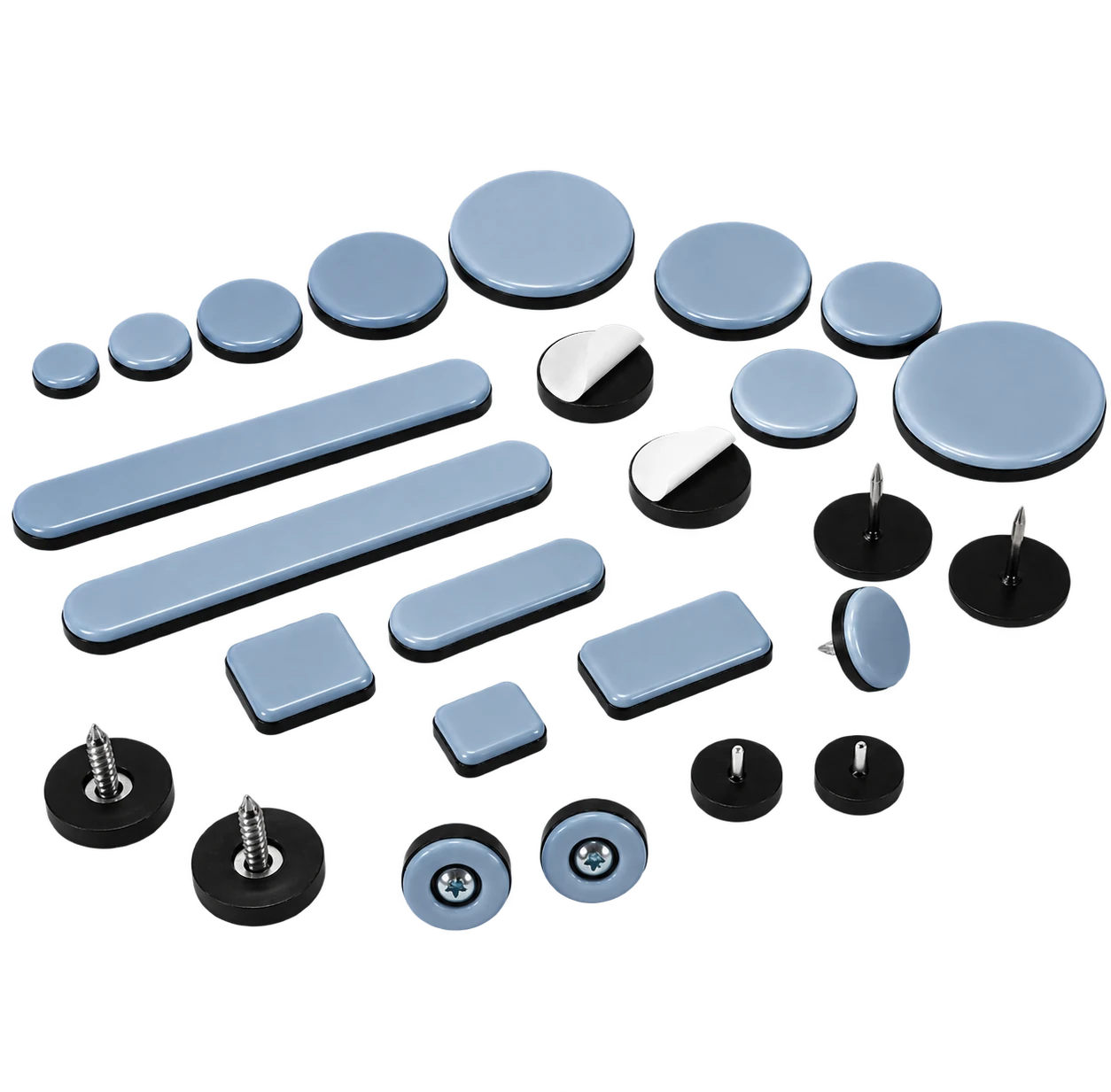
This guide is for furniture buyers who have selected PTFE as a candidate contact surface. It focuses on attachment, rather than repeating the material comparison covered in PTFE furniture glides vs felt pads.
Separate the floor-contact surface from the attachment
PTFE describes the sliding surface, not the entire fastening system. The yiHom glide range uses a PTFE surface with TPU and foam backing, and thickness varies by model. Its self-adhesive, screw-hole and nail-on options should be specified as complete constructions.
Before choosing a method, record the leg material, dimensions at the mounting point, usable flat area and any existing hole. Include an underside photograph. For a hollow, tapered or angled leg, provide a drawing rather than relying on nominal width alone.
| Mounting format | Information to provide | Sample-review question |
|---|---|---|
| Self-adhesive | Surface material, finish, usable area and preparation requirements | Does the selected backing remain attached during the intended use? |
| Screw-hole | Leg construction, hole arrangement and fastener constraints | Can the specified fastener secure the complete glide without interference? |
| Nail-on | Leg material, section dimensions and permitted insertion | Is the attachment suitable for the furniture construction and assembly process? |
Narrow the mounting choice in three steps
- If screws and nails are not permitted, start by evaluating a self-adhesive model and the actual furniture finish. A no-fastener requirement does not by itself prove adhesive compatibility.
- If mechanical attachment is permitted, send the leg construction and available mounting depth. Compare a screw-hole model with a nail-on model only where the furniture can accept the proposed fastener.
- If neither arrangement fits the usable foot area, request a different footprint or a custom construction before ordering samples in quantity.
For example, an existing hole is a reason to request a screw-hole drawing, not to order a glide from its outside diameter alone. The hole position, screw seating and floor-contact clearance still need to agree. This is a selection example, not a specification for a particular furniture model.
When to evaluate a self-adhesive glide
Discuss a self-adhesive format when the design calls for attachment without a screw or nail. That choice still needs a compatible surface and preparation method. Ask the supplier to confirm cleaning, application conditions and the interval before the furniture is put into use.
Check that the pad sits on the usable foot area without unsupported edges. If the foot is narrow or irregular, changing the pad shape may be more appropriate than selecting a larger round pad. Confirm any proposed trimming or modification with the supplier.
Inspect the edge and position of the glide before and after representative movement. Document shifting or lifting. A result on one furniture finish does not establish adhesive performance on every wood, coating or plastic.
What to confirm for a screw-hole model
Request the relevant drawing, then confirm the screw head, shank, length and seating arrangement for the selected model. Ask whether the quotation includes the fastener or only the glide. Review the furniture's mounting depth and the assembled contact face together.
yiHom lists screw-hole glides at Ø22, Ø30 and Ø38 mm. The Ø22 mm model has an approximately 5.3 mm hole. That hole dimension is a product detail, not a recommendation for screw diameter or length. The fastener must also suit the furniture leg and its available mounting depth.
Confirm that the assembled fastener does not interfere with the intended floor-contact surface. An existing hole in a leg is not necessarily compatible simply because its opening appears close in size.
What to confirm for a nail-on model
Nail-on glides need a furniture construction that can accept the specified attachment. Identify the leg material and section size and ask the supplier to review the mounting location. For hollow metal, thin sections or unfamiliar composites, provide a drawing rather than assuming suitability.
yiHom lists nail-on PTFE glides at Ø20 and Ø22 mm. Confirm the nail specification, installation method and finished assembly for the chosen model. Pad diameter alone does not describe the fastener or the minimum suitable leg dimensions.
During sample assembly, review seating and alignment with the intended contact area. Agree on how the attachment will be evaluated during use before accepting the model for production.
Choose a footprint independently of the mounting method
The yiHom catalog includes round, square, strip and oval footprints. Round sizes are Ø20, 25, 30, 40, 50, 63, 70 and 100 mm; square sizes are 20 × 20 and 25 × 25 mm. These catalog dimensions help create a shortlist; they are not interchangeability or load-capacity ratings.
Confirm the actual combination of footprint, backing and attachment. If it is not listed, submit a customization request. yiHom lists custom sizes, shapes, backing structures and installation configurations, with non-standard specifications evaluated for new molds.
Prepare an attachment brief
Include the furniture-leg drawing, material, finish, any existing hole, preferred footprint and intended floor. State whether fasteners are permitted and identify assembly access or replacement constraints. Add quantity, packaging and the required scope of sample evaluation.
Use this short brief to keep the drawing and quotation aligned:
| Brief field | What to supply |
|---|---|
| Furniture reference | Model, leg position and underside photo |
| Mounting surface | Material, finish, shape and usable dimensions |
| Attachment constraints | Fasteners allowed or prohibited; existing holes and depth |
| Candidate glide | Footprint, backing and mounting method to be confirmed |
| Sample decision | Fit, seating and retention checks agreed for the application |
Once the attachment is selected, keep its model and drawing with the OEM sample approval record.
Can a screw-hole glide replace an adhesive pad of the same diameter?
Not automatically. A matching diameter does not confirm matching thickness, seating, fastener clearance or furniture compatibility. Compare drawings and complete samples. If the mounting arrangement changes, review the furniture assembly again rather than approving the replacement from its outside dimension alone.
Which attachment lasts longest?
That requires evidence for the selected construction and use. The current range does not establish a universal service-life ranking between adhesive, screw-hole and nail-on models. Define the furniture, floor, movement and acceptance criteria, then request the relevant sample evaluation or product evidence.
Review the yiHom PTFE glide models and send your mounting requirements. A complete attachment brief is more useful than requesting a mounting method without the furniture details.